
Locations

London

UCAS code

N/A

Start date

13th September 2027

Course length

1 Year (2 years Part-time)

COURSE OVERVIEW

If you’re ready to deepen your technical and scientific knowledge of systems engineering, while continuing to explore sound and music creatively, ICMP’s Audio Engineering and Music Technology Master of Science programme is designed to strike the right balance.

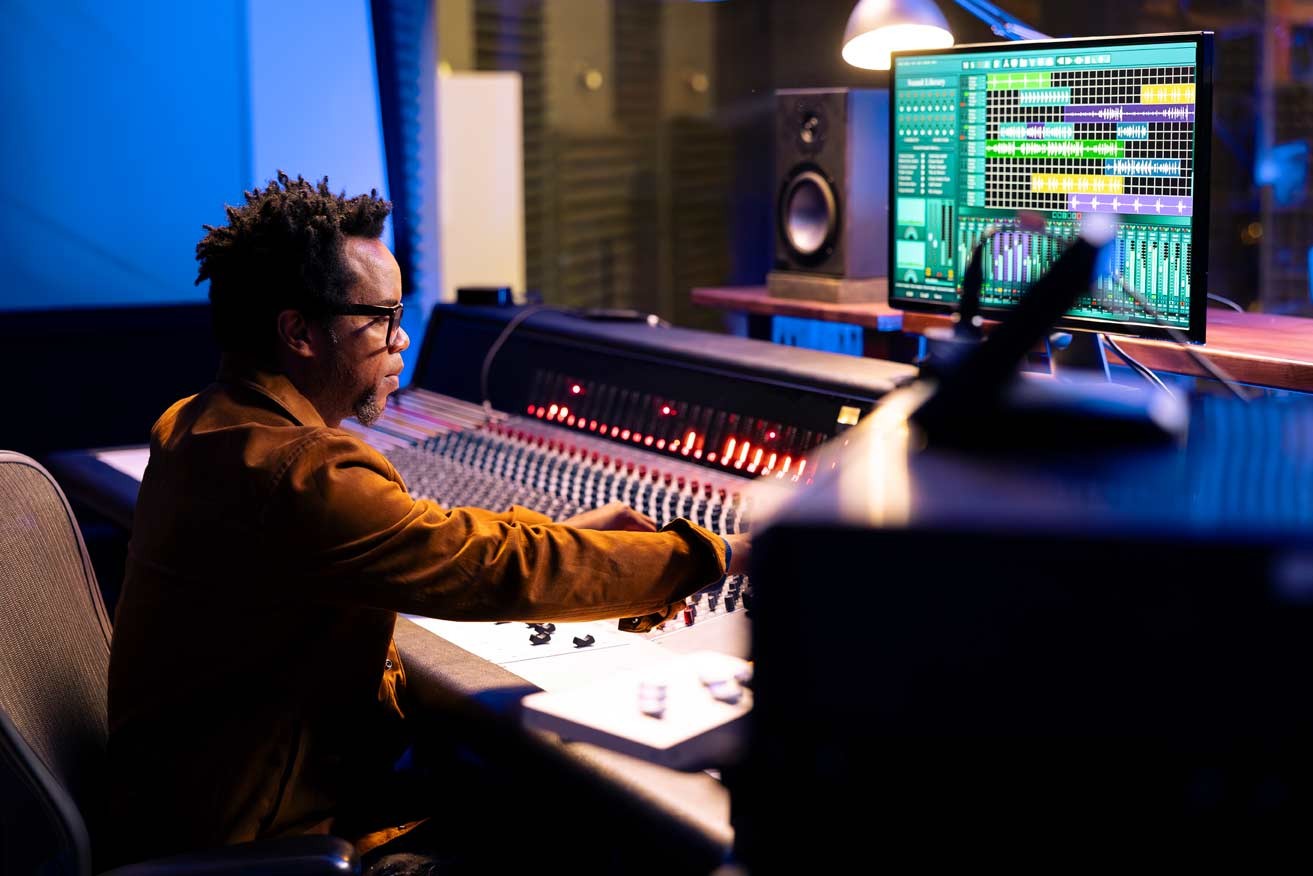
From your first weeks on this one-year full-time or two-year part-time Audio Engineering masters, you’ll work in high-spec recording studios and specialist tech suites, measuring, analysing, calibrating and optimising real-world audio environments with professional tools. You’ll learn from tutors who are experienced audio engineers, producers, immersive audio specialists and research practitioners, bringing modern industry insight directly into the classroom.

Across this sound engineering MSc, you’ll combine innovative music technology practice, advanced audio engineering and critical research skills to develop specialist expertise in recording, production systems and emerging audio technologies. Using industry-standard platforms such as Pro Tools, along with widely adopted professional DAWs, you’ll investigate signal flow, monitoring calibration and hybrid analogue–digital workflows, building a strong understanding of how professional audio environments operate.

Suitable for both recent graduates and experienced industry professionals, this masters in audio engineering will see you develop refined listening abilities, data-driven problem-solving skills and the confidence to design and deliver technically rigorous audio projects.

You’ll collaborate with postgraduate and undergraduate students on complex technical and production challenges, building a portfolio that reflects both engineering precision and creative insight. Your learning culminates in an exciting masters-level Integrated Studio Production Project, where you’ll study an area of technical, scientific or creative interest of your choosing.

Whether you see your future in studio production, immersive audio, hardware and software development or spatial sound design, you’ll graduate ready for a successful career in music technology, driven by the exciting prospect of what lies ahead.

FINANCIAL SUPPORT
Financial support is available to students studying this postgraduate degree in audio engineering at ICMP. Eligible students on audio engineering graduate programmes will be able to access a postgraduate masters loan in the same way, and at the same value, as they could at a publicly funded provider.

If you opt to study part-time, your loan would be split into two instalments over the two years.

Course Fees

ICMP Music School Logo

Successful completion of the MSc Audio Engineering & Music Technology course leads to the award of Master of Science degree by The Institute of Contemporary Music Performance.*

Click to view the full terms and conditions for applying to study at ICMP.

Programme Specification

Want to Join in September?

Great! Start your application by completing this short form and we'll guide you every step of the way.


Key facts

  • Study emerging music technologies and advanced technique in this intensive one-year audio engineering MSc.
  • Also available as a two-year part-time programme (UK students only).
  • Develop specialist scientific expertise in studio systems, acoustics and professional production workflows.
  • Explore immersive, spatial and object-based audio formats, shaping the future of sound.
  • Learn from experienced engineers, producers and research-active specialists.
  • Strengthen your critical listening, analytical thinking and research methodology skills.
  • Get creative with professional DAWs including Pro Tools.
  • Immerse yourself in the global music scene.
  • Design and optimise recording environments using industry-standard tools and measurement techniques.
  • Complete a substantial masters project, showcasing technical authority and innovation.
  • Connect with the wider music industry to build an impressive musical network.
  • Graduate with a research-informed portfolio setting you up for doctoral study or a senior audio engineering career.

    Apply Now

UCAS CODES

COURSE DETAILS

Modules

The MSc Audio Engineering and Music Technology is delivered over one year full-time. The programme combines taught modules, practical workshops, technical laboratories, seminars and independent research. You’ll move from advanced theoretical exploration and technical experimentation into increasingly self-directed specialist work, culminating in a substantial master’s project at the end of your studies.

STUDIO SYSTEMS AND ACOUSTICS

In this module, you’ll build an advanced technical understanding of professional studio environments, exploring how acoustics, monitoring systems and studio design influence production outcomes. Through a blend of theory and practical investigation, you’ll examine signal flow, system architecture and room behaviour within contemporary recording and production contexts.

Working in studios and technical suites, you’ll learn how to measure, analyse and optimise working spaces using industry-standard tools and methodologies. With a strong emphasis on critical listening, technical decision-making and professional documentation, you’ll develop the skills needed to diagnose and resolve complex technical and acoustic challenges in real-world production environments.

  • Studio signal flow and systems architecture
  • Acoustic principles and room behaviour
  • Loudspeaker placement and monitoring calibration
  • Measurement techniques (including SPL, frequency response and RT60)
  • Studio optimisation and troubleshooting strategies
  • Integration of analogue and digital production systems
  • Technical documentation and reporting
  • Research-informed case studies of professional studio practice

ADVANCED STUDIO PRODUCTION AND CREATIVE WORKFLOW

This module develops a critically informed, professional approach to advanced studio production. You’ll explore how recording, editing, mixing and creative decision-making are shaped by workflow design, system architecture and production strategy in contemporary studio environments.

Through practice-led studio work and analytical study, you’ll examine how technical constraints, creative intent and professional briefs interact to shape production outcomes. Emphasis is placed on reflective practice and experimental exploration, helping you build adaptable workflows for complex production challenges.

  • Workflow and session design for advanced productions
  • DAW session architecture, signal routing, and template management
  • Advanced recording, editing, and comping techniques
  • Microphone techniques for instruments, vocals and ensembles
  • Hybrid analogue–digital production approaches
  • Mixing strategies supporting depth, clarity and spatial coherence
  • Sound design and creative signal processing
  • Collaborative and remote production methods
  • Reflective documentation of production processes and outcomes

AUDIO TECHNOLOGIES AND IMMERSIVE PRODUCTION

In this music technology course module, you’ll explore contemporary and emerging audio technologies, with a focus on immersive, spatial and multi-channel production environments. You’ll critically examine how new formats, systems and standards are reshaping professional production and post-production across music, media and interactive contexts.

Through hands-on experimentation and technical evaluation, you’ll design and implement immersive audio workflows while considering perceptual, technical and practical factors. The module supports your ability to adapt production approaches in response to evolving technologies and industry expectations.

  • Principles of immersive and spatial audio
  • Multi-channel and object-based audio formats
  • Monitoring strategies for immersive environments
  • Immersive workflow design and system configuration
  • Perceptual and psychoacoustic considerations in spatial audio
  • Emerging audio technologies and production standards
  • Technical evaluation of immersive systems
  • Professional applications of immersive audio practice

RESEARCH INNOVATION AND CRITICAL PRACTICE IN MUSIC AND SOUND

This module develops the research skills and critical frameworks required for advanced study and professional practice in audio engineering and music technology. You’ll explore qualitative and quantitative research methodologies, learning how to formulate focused research questions and evaluate academic, technical and industry sources.

With an emphasis on critical analysis, innovation and ethical practice, the module supports research-informed approaches to technical and practice-based enquiry. It also prepares you for independent postgraduate-level study and the planning of extended project work.

  • Research methodologies in audio engineering and music technology
  • Academic and professional literature review
  • Practice-based and technical research methods
  • Data collection, analysis and interpretation
  • Innovation and critical practice in music and sound
  • Ethics and professional responsibility
  • Academic writing and technical documentation
  • Research preparation for extended project work

INTEGRATED STUDIO PRODUCTION PROJECT

This double module represents the peak of the music production MSc programme, providing the opportunity to undertake a substantial, self-directed project within a professional studio or research context. You’ll integrate advanced technical knowledge, research and creative practice to realise an original project aligned with your professional or academic interests. With supervisory support, you’ll plan, execute and critically evaluate a complex studio-based production, system design or applied audio engineering project. The module emphasises autonomy, technical rigour and reflective evaluation, preparing you for advanced professional practice or further research.

  • Project proposal and research development
  • Advanced studio practice and technical implementation
  • Independent investigation and experimentation
  • Workflow management and problem-solving
  • Critical evaluation of process and outcomes
  • Professional and academic documentation
  • Presentation of technical and creative work

Teaching, Learning and Assessment

Teaching takes place accross our London campuses, where you’ll use professional recording studios, live rooms, tech suites, and dedicated teaching spaces. You’ll also have access to these facilities outside scheduled class time to support your independent practice.

You'll be in timetabled teaching activities such as lectures, seminars, practical classes, online content and workshops for typically 10-12 hours a week,

Support is available from our Student Services team, who can provide guidance on welfare, finance, personal development and safeguarding. You’ll also have access to our professional development team, The Hub, which offers tailored music industry careers advice and opportunities to connect with the wider industry.

Teaching and Learning

On the audio engineering masters programme, you’ll be taught through a combination of lectures, seminars, workshops and practical sessions delivered across our London campuses.

Outside scheduled teaching, you’ll be expected to continue your learning independently through self-directed study. This will include engaging with academic and professional literature, working on individual and collaborative projects, conducting research and preparing assessments. Your independent learning is supported by access to the Learning Resource Centre, performance and rehearsal spaces and well-equipped studio and technical facilities.

ASSESSMENT

Modules are assessed through a variety of means, including technical portfolios, system design documentation, research reports, practice-based technical investigation and critical evaluation.

ENTRY REQUIREMENTS

Applicants will normally hold a good honours degree (upper second class or first class) in audio engineering, music or a related discipline, and be able to demonstrate advanced musicianship alongside strong theoretical, technical, practical and conceptual skills.

Applications are also welcomed from experienced practitioners who do not hold a music degree but can demonstrate professional or advanced practical experience. Applicants considering this route are encouraged to contact the Admissions team for guidance before applying.

International applicants must meet the English language requirement of a minimum B2 level on the Common European Framework of Reference for Languages (CEFR).

Please note that international students who require a UK visa are only eligible to study on this course full-time.

When completing the full application form for the MSc, you will be asked to submit a personal statement outlining your interest in the programme. This should include details of your previous study and experience, academic and professional goals, areas you wish to develop and reasons for choosing this course.

You may also be required to attend an interview, and in some cases provide additional supporting documentation or evidence as part of the application process.

UCAS code N/A

HOW TO APPLY

Please apply via the ‘APPLY NOW’ link below.

If you need further advice during the application process, contact our Admissions team who’ll be happy to help.


By phone:
020 7328 0222

By email:
enquiries@icmp.ac.uk

or