
London’s Best Nightclubs
We explore some of London's best nightclubs from the past to the present…

London has been one of the homes of UK clubbing ever since electronic music culture first emerged.
Of course, the nature of nightlife is transitory with great nightclubs coming and going as the capital's urban landscape changes and evolves.
It takes a combination of good luck, resilience and an adaptable mindset for venues to survive and only those with a willingness to evolve have been able to weather various storms. Many are currently raging hard due to a combination of a cost of living crisis, spiralling operating costs and a culture still feeling the impacts of the pandemic.
To mark the launch of our one year Cert HE DJ course, our blog celebrates some of London's greatest clubs. This is by no means an exclusive list - the Wag Club, Cable, T-Bar, Bar Rumba and more are not featured. But the ones we have included are among some of the best past and present - learn why they have been so important and influential to DJ culture below…
Crackers
To be found on Wardour Street in Soho in central London in the late seventies, Crackers is heralded by many of dance music greats as a key club. Luminaries including Carl Cox, Fabio, Ashley Beedle, Terry Farley and Norman Jay all found themselves in the venue at some point with the latter describing it as "our Paradise Garage".
DJ Mark Roman was in charge of the upfront selection of soul and funk tunes but it was the collection of dancers that he managed to attract to this unassuming and slightly sleazy space that made it so legendary.
Commenting on the club in an interview with Red Bull, Norman said: "It was the first (London) meeting place of black, white, straight, gay. The clientele originally was very gay. It wasn't a gay club per se, but it was hip and fashionable."
The music was brilliant, but it was the coming together of different social groups and races. That was what was groundbreaking."
Find out more | Listen to David Ruffin's 'Walk Away From Love', a Crackers classic (c/o DJHistory)
The Blitz
Nestled in Covent Garden, the Blitz Club was the hub for the New Romantic scene, a club opened and run by tuned-in scenesters Steve Strange and Rusty Egan. This was where fashionistas, artists, musicians and emerging talent would gather to dance the night away from the end of the seventies.
The so-called Blitz kids were the regulars who made up the crowd with Boy George, Marilyn, and future members of Spandau Ballet among their number. The soundtrack featured Kraftwerk, David Bowie, Iggy Pop, Roxy Music and more.
Boy George celebrated the Blitz Kids scene in his 2002 musical 'Taboo', in which he played the part of Leigh Bowery, who hosted London's fortnightly club-night called Taboo in 1985-87, long after the Blitz closed.
Listen to this selection of tracks played by Rusty Egan at the Blitz.
Heaven
Heaven was a London nightclub that opened in 1979 under the arches near Charing Cross Station. It quickly became a significant venue for the LGBTQ+ community and a major force in shaping London's gay scene.
It was nightclub entrepreneur Jeremy Norman who transformed this former run-down roller disco into a vast, multi-room club fit to rival New York's renowned Paradise Garage.
The club's first resident DJ, Ian Levine, pioneered the emerging sounds of Hi-NRG, a faster style of disco or electronic music that became hugely popular in gay clubs during the eighties.
Rage was another of Heaven's most influential nights, a club where Fabio and Grooverider DJed at the start of the nineties. As the video below describes: "Rumbling bass-lines, narcotic synth rushes and roughly chopped and sped-up breakbeats all merged into a style that we now know as jungle."
The Blue Note
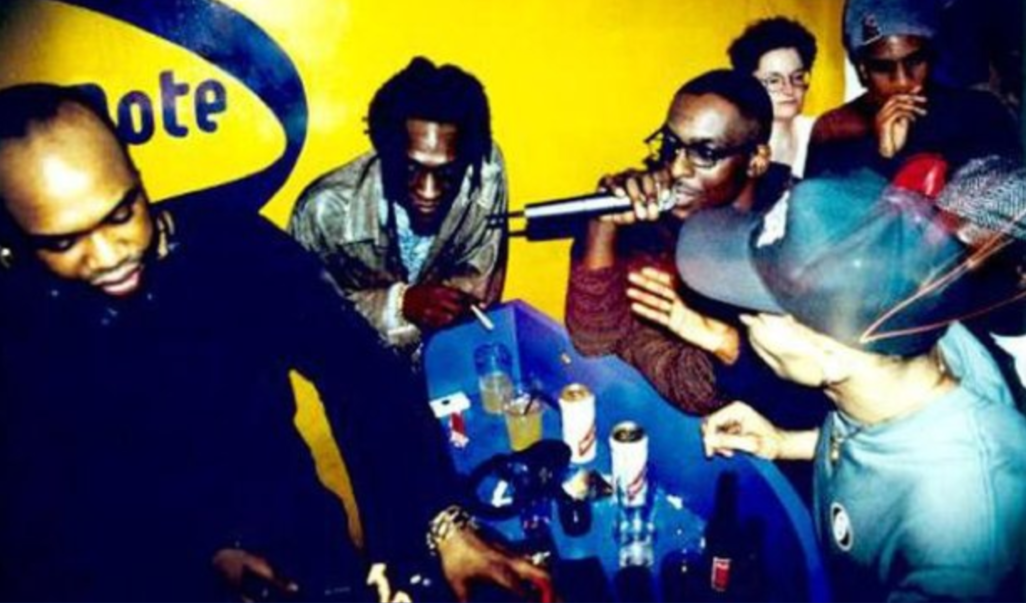
The Blue Note was initially opened in London's Hoxton Square by Acid Jazz record label founder Eddie Piller in 1993 after he bought a derelict jazz club called Bass Clef.
At this point, East London was far from being the hipster hotbed that it has become. But the club took off and formed a hub for like-minded music lovers and club goers while simultaneously helping smooth many of the areas rougher edges.
Metalheadz at the Blue Note was one of the venue's most important nights, a Sunday session where the emerging drum'n'bass scene had its own space to evolve.
Founder Eddie Pillar told the Guardian: "I approached the club in the same way that I approached the record label. Each night had to be different, but run by the best people for the job. So the best drum'n'bass night would be Goldie and Metalheadz; the best breakbeat night would be Coldcut or James Lavelle; the best dub night would be Aba Shanti."
It took a few months for people to get their heads around going to that part of London - Shoreditch, as it's now called - and staying out until 5am, but eventually it was full seven nights a week."
The End
Launched in 1995 by Layo Paskin and Mr C of the Shamen and designed by Layo and his architect father, Douglas Paskin, The End was once THE night-time hotspot in London's West End.
This brilliant two-room club was home to some of the capital's most legendary nights including Erol Alkan's infamous Trash Club. Taking place on Monday evenings, this was originally a hot-bed of indie sleaze and new rave, a sound artists like Charli XCX and The Dare have utilised as a creative springboard in 2025.
Legend has it that US electronic punks LCD Soundsystem played their second ever live gig at the club and it hosted many memorable nights for DJs playing house, techno and drum'n'bass before closing in 2009.
The last ever tune was played by London DJ Matt Walsh at an epic final party - listen below:
Plastic People
A small capacity club but with a heavyweight reputation, Plastic People is still talked about in hushed tones despite its doors having shut over a decade ago. Located in the heart of Shoreditch, this basement venue was created by Ade Fakile and was home to many legendary nights and an even more legendary sound system.
FWD was perhaps its most influential night, a bubbling dubstep session while other names including Theo Parrish, Floating Points and Four Tet were all regulars to grace the venue's DJ booth.
Those who revere Plastic People remember the community Ade created around the venue, drawing on a diverse range of sounds and sonics.
In an interview with the Guardian, Floating Points said: "Although Shoreditch has now become apocalyptic after 1am, Plastic People never changed. We all maintained that it's a safe haven away from it all."
The people coming down to the nights were so nice, and became regulars; suddenly it became a room full of 200 friends. You knew their dance moves, you knew the guy who screams when you played a certain track. It didn't feel like randoms off the street."
Ministry of Sound
Ministry of Sound opened in 1991 with co-founder Justin Berkmann, Jazzy M and Paul Oakenfold on the decks. More than 30 years later and the club continues to pack dancers into its home on Gaunt Street near Elephant and Castle.
The club became a nightlife leader not only for its booking policy and brilliant sound but the way it has evolved into an all-conquering brand. Ministry is a prime example of a space realising that what it does off the dancefloor is equally important to its longevity as what happens within it. For Ministry, this has included compilations, external events around the world, radio sessions and much more.
Its logo is one of electronic music's most recognisable and shows how the club has come a long way since Justin returned to London from an inspirational trip to New York clubs during the late eighties.
Fabric
Fabric was the first leftfield superclub, the first large cap venue that acted as a conduit from London's electronic underground to the mainstream, making stars of many of the capital's coolest selectors.
Musically helmed by the brilliant resident Craig Richards with the business operated by Cameron Leslie and Keith Reilly, it opened in 1999. The club features three finely tuned rooms and has supported many styles and genres over the years from tech house to dubstep and beyond.
The club has been forced to navigate numerous challenges too, most notably when it was closed in 2016. The decision to shut down Fabric was made by Islington Council in north London, which described a "culture of drugs" at the venue after the deaths of two teenagers.
It subsequently reopened later that year after a high profile campaign to save the venue and stricter conditions surrounding its licence.
Printworks
Housed in what was a huge printworks, this club space (pictured at the top of this article) was opened by Broadwick Live in 2017 with a party featuring the talents of The Martinez Brothers, Seth Troxler, and Loco Dice among many others.
It rapidly became a go-to destination for the capital's party people, attracted by the quality bookings alongside the impressive venue in Rotherhithe. The industrial feel was retained by many of the original features being kept in the club's design.
The venue subsequently closed its doors in 2023 after the site owners, British Land, submitted plans to Southwark Council to redevelop the it into office buildings. This provoked much wide-spread concern across the dance music community - but plans have been unveiled to announce a reopening in 2026. Clubbers will be delighted to know that the most appealing features of the original, most notably the infamous Printworks press halls, are expected to be preserved.
The Cause
Originally opened in Tottenham Hale by the inspiring promoter Stuart Glen, The Cause is a multi-room space that has moved between different locations, taking its dedicated community with it.
The venue first landed in 2018 and featured a community garden and cafe among its raucous club programming and what became a labyrinth-esque space with multiple rooms and corridors for ravers to get lost in.
After The Cause was moved on, in part by their temporary lease and the ongoing redevelopment of Tottenham, the venue left and found a new home in London's Docklands. Dubbed 'The Cause 2.0', the new location can offer various capacities depending on the event alongside five indoor rooms and a large outdoor courtyard with high-end sound. Combined with their excellent bookings and charitable arm (the team has raised thousands for charity since opening), this is one of the capital's most exciting venues.
Take the first steps in your music career with ICMP
We've been developing and delivering contemporary music education for over 40 years – longer than any other music school in the UK. With a proven track-record, countless music industry connections and unrivalled access to facilities, it's easy to see why hundreds of students choose ICMP each year.
To completely immerse yourself in your music career, chat with our friendly Admissions Team via email enquiries@icmp.ac.uk or give them a call on 020 7328 0222.
Find your course
We've been developing and delivering contemporary music education for over 40 years – longer than any other music school in the UK. With a proven track-record, countless music industry connections and unrivalled access to facilities, it's easy to see why hundreds of students choose ICMP each year.
To completely immerse yourself in your music career, chat with our friendly Admissions Team via email enquiries@icmp.ac.uk or give them a call on 020 7328 0222.